
Guest post by Lorraine Tosiello
Louisa May Alcott faced a lifetime of challenges, from poverty to illness. One of her early personal challenges, one that might, in fact, have given her the resolve to prove she could be a successful author, occurred in Dedham, MA.
In the winter of 1851, when Louisa was eighteen years old, she “went out to service” as a companion to the sister of Mr. James Richardson of Dedham. Louisa’s understanding was that she would be expected to undertake light duties related to her companionship of Elizabeth Richardson, a forty-year-old frail, shy, neuralgic woman. (1) Instead, she was forced to serve the brother, ultimately enduring sexual harassment, as her short story “How I Went Out to Service” reveals.
Among Alcott’s duties was organizing Mr. Richardson’s study. Alcott writes in her fictional account that her employer detained her when she tried to leave the study, remarking, “I like the graceful cap, that wifely apron, and I beg you will wear them often, for it refreshes my eye to see something tasteful, young, and womanly about me.” (2) Standing up for herself, Alcott challenged him while cornered among soapsuds, scrubbing the hearth and made him understand that she preferred hard work to being compelled to remain in his presence while he read Hegel aloud. The employer retaliated and gave her more and more menial chores to accomplish. “Far be it from me to accuse one of the nobler sex of spite or the small revenge of underhand annoyances and slights to one who could not escape and would not retaliate…” (3) Alcott wrote, using the criteria that constitute workplace harassment today. (4)

Photo by Lorraine Tosiello
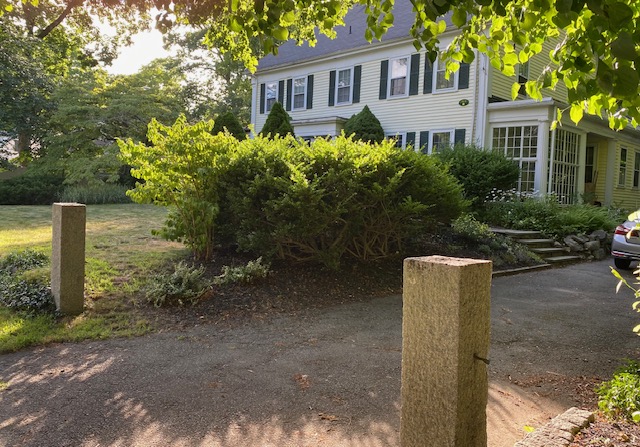
The fictional minister of her story was in fact lawyer James Richardson of Highland Avenue in Dedham. (5) Though Alcott described the abode as “a stately mansion, fast falling to decay” the exact location of the home is unknown. The Dedham Museum and Archives shared this information about James Richardson’s residence: “In 1843 he owned a house and a barn…in 1844 he had two houses and a barn…on Highland Avenue, just off Court Street in the First Parish. There were no numbers assigned to houses at the time.” (6)Armed with this information, I paced along Highland Avenue off Court Street. The street displays an eclectic array of architectural styles from the Federal to the late twentieth century. There was no way to identify the exact home. But, wait, I remembered a discovery mentioned on the Louisa May Alcott Facebook page by member Aniko Nagy, who posited that she had found the site of the Roxbury Rest Home where Alcott died by identifying the hardscape: a stone wall that remained, though the building was gone. On Highland Avenue, one home, the first on the right off Court Street, bore a historic marker 1840. It had four solid cement pillars, two on each side of the house.
Two pillars flank the driveway, the other two flank nothing, leading only to the home’s side yard. One might assume that these two lead to another home at one time. Richardson owned two homes on Highland off Court. I propose the possibility that the Richardson home where Louisa worked was either the existing home or one demolished near the second set of pillars.

Dedham has another, more pleasant association with Alcott. Sophia Foord, her beloved teacher from the first idyllic Concord days, lived a few doors down from the Richardsons on Highland Avenue. (7) Again, no street numbers are available from the Dedham Archives. Only one house remains “a few doors down” from the one I posit as Richardson’s, with a historical marker of 1840. It is a feminine cottage, and it is lovely to imagine that Ms. Foord lived there with her sister Esther! However, it is unlikely that this was Miss Foord’s house, but perhaps a home that Louisa would have seen on a walk to visit her kind mentor during her tortured days with the Richardsons. Jennifer Sarra, a Foord researcher, reminds me that the Foords ran a boarding house and had many siblings who lived together.

Photo by Lorraine Tosiello
What is definite is that Sophia Foord is buried in the cemetery adjacent to Highland Avenue. When Foord died in 1885, Alcott wrote condolences to her sister. She also wrote a tribute about Foord in the Women’s Journal, saying, “Sophia Foord was one of those who by an upright life, an earnest sympathy in all great reforms and the influence of a fine character, made the world better…” (8) What a remarkable tribute to a teacher who had touched her life four decades before!
Another part of this story comes full circle decades after the “Dedham incident.” In 1862, Alcott offered her short story to James T. Fields for publication. He rejected it, saying, “Stick to your teaching you can’t write.” To punctuate his statement, he loaned Alcott forty dollars for the kindergarten she was opening under the mentorship of Elizabeth Peabody. In her journal, she recorded “…a wasted winter and a debt of $40—to be paid if I sell my hair to do it.” (9) Alcott did not last the semester, claiming “I won’t teach; and I can write, and I’ll prove it.” (10) Years later, after the financial windfall due to Little Women, she repaid the debt. Perhaps her indignation and determination fueled the success she knew she could achieve. Interestingly, the story of her humiliation was finally printed in 1874, more than twenty years after the event, a testament to the lifelong impact it had on Alcott. Thus, in many ways, Dedham remained a powerful memory for Alcott.
Resources
(1) Parr, JL. Dedham: Historic and Heroic Tales from Shiretown. History Press, 2009. “A Cinderella in High Street.” p. 71-74.
(2) Alcott, LM. “How I Went Out to Service. A Story.” The Independent, Vol. XXVI, NO.1331 (June 4, 1874).
(3) Ibid.
(4) U.S. Equal Employment Opportunity Commission, accessed 7/24/2024 at https://www.eeoc.gov/harassment
(5) Parr
(6) Personal communications from Dedham Museum and Archive
(7) Parr
(8) Alcott, LM. In Memoriam: Sophia Foord. Women’s Journal, April 11, 1885.
(9) Myerson J, et al. The Journals of Louisa May Alcott.Little, Brown and Company. Boston 1989, p. 109.
(10) Ibid.
 Are you passionate about
Louisa May Alcott too?
Subscribe to the email list and
never miss a post!
Facebook • Instagram • Twitter
 Find Susan’s books here on Amazon
Are you passionate about
Louisa May Alcott too?
Subscribe to the email list and
never miss a post!
Facebook • Instagram • X

 Louisa May Alcott is My Passion
Extremely interesting! Thank you, Lorraine!
This is such a lovely post, Lorraine! (Also thanks for the mention!) I didn’t know anything about Sophia Foord. I would love to learn more now about her friendship with LMA. I love the image of Alcott perhaps visiting Foord for support during her Richardson ordeal.
I’ve been researching the question of the Richardson house location, too, and I have a couple of theories, too, of which house/site it might have been. I’d love to share and discuss at some point.