
In the early twentieth century the world was changing at a breathtaking rate. As a country we moved onto the global stage with the Great War. Dazzling technological innovations created time- and work-saving devices along with new entertainment venues. Medical breakthroughs promised longer and healthier lives. Now that day-to-day survival was no longer the all-consuming task, people had time for leisure, to think and to create.
How did Little Women fare in this changing world?
Beverly Lyon Clark, in her book, The Afterlife of Little Women, indicates that people were already waxing nostalgic about Little Women even though the book was only thirty-two years old by 1900. Adults generally found the book to be “old-fashioned” while children continued to love it. (pg. 42).
Do you consider Little Women to be timely despite its age? What about the book transcends time?
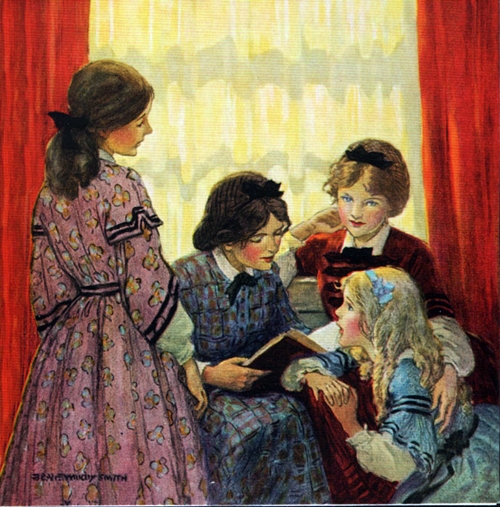 Despite the book’s enduring popularity, Little Women was not held in high esteem by scholars mostly because children’s literature had not yet attained any status. (pg. 43). Yet G. K. Chesterton notes that there are “few women in England, from the most revolutionary Suffragette to the most carefully preserved Early Victorian, who will not confess to having passed a happy childhood with the Little Women of Miss Alcott.” (pg. 48). The universal appeal of Little Women speaks to Louisa’s genius, a genius nurtured by an upbringing combining progressive ideas with traditional values.
What are the universal themes of Little Women? Why does it still speak to you today?
 In his essay, “Portrait of Louisa May Alcott,” Gamaliel Bradford was one of the few who praised Louisa’s artistry: “The worshippers of art for art’s sake may sneer at her but the great poets don’t necessarily deserve much more of our gratitude than those who make our souls forget by telling charming stories.” (pg. 53-54). Clark notes that Bradford observed that Louisa may have been motivated more out of a sense of duty rather than love to help her family out of poverty.
Do you consider Little Women to be a work of art? Why or why not?
Yet it is the safer traditional values of home and family that maintained the book’s popularity, generating the spinoffs of a Broadway play, two silent films and several novel series. With World War I jading the population, Little Women was likely seen as a return to “the good old days” despite being considered “too sweet” by many in the tumultuous twenties (pg. 49).
The adaptations began with children’s books. Clark writes, “If ‘publishers complain of the scarcity of good books for girls, and their readers say that no successor to Louisa Alcott has yet to come to view,’ then one approach was to reframe Little Women.” (pg. 58). She lists Seven Little Australians (1894) by Ethel Turner, Sisters Three (1900) by Jessie Mansergh, The Little Women Club by Ames Taggart, Four Little Women of Roxby, or The Queer Old Lady Who Lost Her Way (1926) by May Hollis Barton, and the four books in Gabrielle Jackson’s Three Little Women series (1908-14).
 Of these books Clark found the Three Little Women series to be the “most interesting in how it addresses the cultural moment even as it attests the continuing significance of Little Women … For it harbors inconsistencies that speak to cultural contradictions at the beginning of the century, especially those associated with the occupational opportunities available to the New woman and the continuing expectations of domesticity, at a time when Alcott might be called ‘one of the finest of pioneer American business girls.'” (pg. 62)
A detailed analysis of this series, along with other adaptations and spinoffs (including the Broadway play as we shall see, and the silent films) begs the conclusion that while Louisa was lauded, she was not to be imitated.
What I found most interesting in Clark’s analysis was the differing interpretation of “littleness” in Alcott’s book and Jackson’s. Frances Armstrong has noted that for Alcott littleness at times entailed diminishment but at other time was a means to greatness. In Jackson’s novels–with their “little girls,” “little mothers,” “pretty little rooms,” “trembling little fingers”–diminishment is the rule.” (pg. 67)
Did Jackson miss the deeper spiritual dimension of littleness as described by Alcott? Beth was indeed “little” but she demonstrates largeness in her example of courage with the Hummels, literally risking her life to comfort the dying baby. Her tending to headless doll Joanna provides a metaphor for a more public caring of the disabled, aka, the “least of these.” In exploring the spiritual dimension of littleness, Alcott uncovers its greatness. Judging from Armstrong’s remarks, Jackson appears to have missed that point entirely, reflecting a more secular approach to the story.
How do you think Louisa viewed “littleness?” How do you feel about the character of Beth?
In part two of this post, I will discuss the Broadway play (which, by the way, is available for free through Google Play Books; it’s called “Little Women: A Comedy in Four Acts” by Marion de Forest) and silent films, and the creation of the Orchard House museum home.
 Are you passionate about Louisa May Alcott too?
Subscribe to the email list and never miss a post!
Facebook Louisa May Alcott is My Passion
More About Louisa on Twitter
 Louisa May Alcott is My Passion
I shall always love Little Women, and yes, I think it is relevant to our world today. We need to get back to the basic rules of life, like marriage, home, children, and a loving family with a mother and father. The children in Little women depicted how the love came through after the quarrels. We need more of this attitude and to teach it to our children, forgiveness and forbearance with one another, plus demonstrate it ourselves in our families.
Also respect for the parents, which is definitely needed today, and the parents must work toward having a loving relationship with each other and with the children, just like the mother in “Little Women. How I wish I could go back and live my life again after reading this book, it is such an inspiration. But working toward a better future with my children and grandchildren. Will always recommend “Little Women” to my children and grandchildren. It is a beautiful story, full of wonderful examples to follow.in life.
There are many timeless values in Little Women to be sure.
I agree completely with the above comment by raynarenee. Something that I have been thinking about as well is how beautiful “goodness” truly is. A good story, a good gesture, a good attitude etc. How good our God is to us. Little Women seems to elevate goodness in a way that has really stuck with me.
Little Women truly does address universal themes. It’s amazing how readers from many different beliefs, backgrounds and cultures find something inspirational about the book. Your comments about the beauty of goodness are lovely; I too love that message in the book.
I definitely think Little Women has timeless values – and although people often belittle it as a children’s novel, there are a lot of deep themes in there, about developing character and independence (Marmee encouraging her daughters not to just marry someone wealthy is actually quite revolutionary, I think) that I think are often lacking in modern books. Perhaps that’s why these simple stories (Anne of Green Gables is another, and LMA’s “An Old Fashioned Girl”) are so perennially popular?
I read recently in a book called From Little Houses to Little Women (a book I will be reviewing soon) about how books today emphasize girls taking revenge on each other, and being petty, vain and self-absorbed. And of course, how many times do we see that on the TV and in movies? How does this teach a girl to become an autonomous, caring and strong woman? Little Women does far more to encourage the right kinds of values that make a person compassionate, loving and a valuable contributor to society.
I agree with the statements made. I am creating a power point presentation for my Children’s Literature class. I find her to be an important reminder not to allow our rights and opportunities to be taken away or forsaken by a very troubled society both here and globally. It is time for the Big women to continue growing forward
Agreed!