
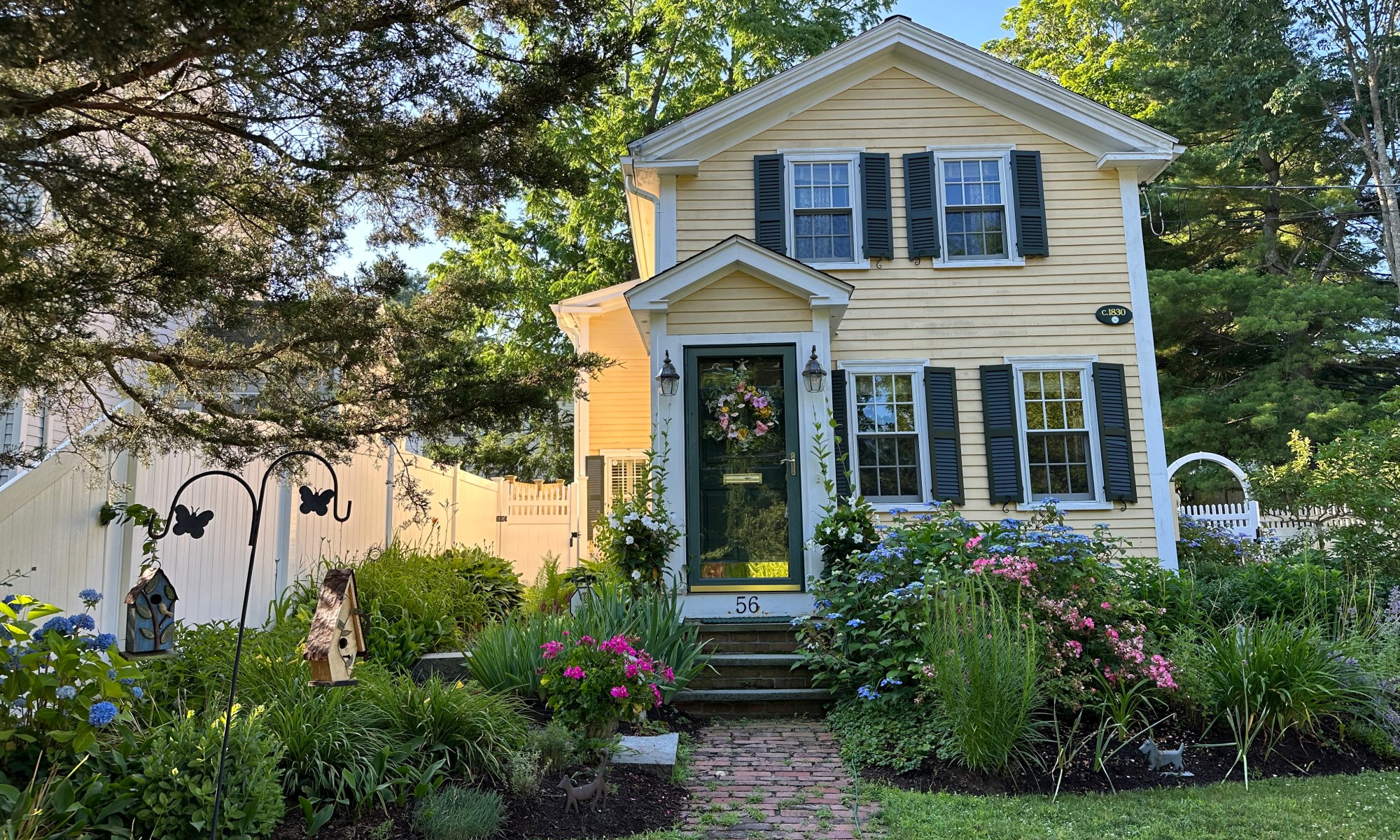
Editor’s note: Earlier this year, Lorraine Tosiello wrote about Louisa May Alcott’s “Dedham experience.” Alcott certainly spent time as a companion and housemaid at the Richardson home on Court Street. She mentions later in life that Sophia Foord, her former teacher and mentor, helped her through her difficult time in Dedham. In this article, Aniko Nagy pinpoints one of the two Richardson homes on Court Street. The home photographed in the precious article is, in fact, the Foord home, not a Richardson home. Let’s walk in Alcott’s footsteps along Court Street and imagine the topography of the time.
There’s something that seems to be meaningful to be on the same street where someone special lives. Lerner and Loewe put the very sentiment into a love song. For me, the sentiment is perhaps more resonant when it comes to people from history. Anyone who has ever been on a literary pilgrimage understands. And what Louisa May Alcott lover has not wanted to go on an LMA literary pilgrimage? Some of us have been fortunate to do so, but even then, there do seem to be sites that are missing from the usual itineraries. They’ve been somewhat of a mystery, but there doesn’t seem to be much reason for the mystery to go unsolved, or uninvestigated.

One particular event in LMA’s life that may have piqued your curiosity, as it did mine, is her experience in Dedham, Massachusetts for an eccentric man of wealth whose mistreatment drove her to quit and even to refuse her salary, i.e., the experience on which Alcott’s “How I Went Out to Service” was based. Lorraine Tosiello recently shared her research on the mystery of Richardson’s house and Alcott’s experience there. It was a mystery that I also had been interested in for years. Lorraine’s inclusion of and research on the house of Alcott’s friend Sophia Foord added richly to the whole question of what Alcott’s daily situation may have been like beyond the story itself. What did the house look like? What did the neighbor houses look like? Where would she have gone in those instances when she had a moment or two to herself?
Fortunately, the area in which Richardson lived is one that is rich with old houses and love for history. Dedham even has its own museum and archive. When I did some research, I found out that the historians at the archive had a file on number 56 Highland Street, an old house on a property once owned by Richardson.
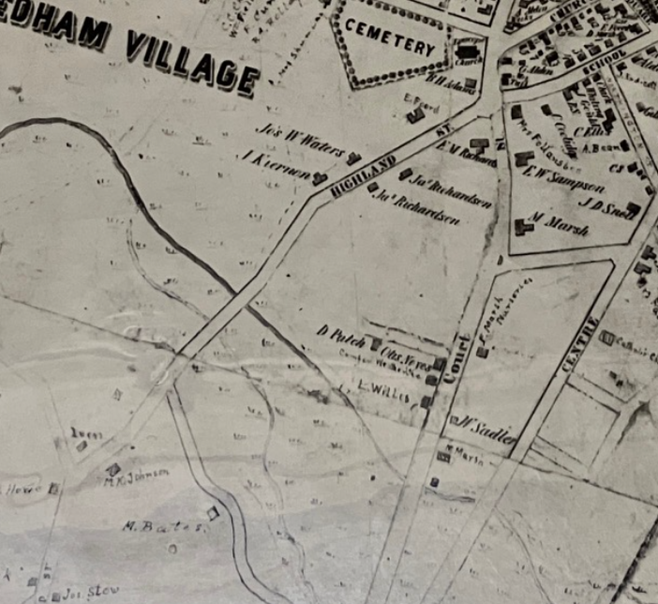

To compare a historical view of that property on an old map to the same area on Google Street maps is a pretty stunning experience.(1) It is so easy to picture Alcott’s old, temporary stomping grounds in those few weeks in 1851. The triangular tract that forms the block lends itself easily to the comparison. You can see the same old main streets, some of the same sites, and where structures, and even streets, have been added. But not everything is obvious, which is understandable and fitting for an old street in the modern day. We know that Richardson’s property was on the right side of Highland Street because the old map identifies his buildings. But are those buildings still there? And precisely which buildings were those?
Happily, the researchers at the Dedham Archive know their neighborhood! In the file, they ascertained that James Richardson owned six acres with two different houses as well as a barn in 1850 and 1856. This paints a basic picture quite nicely of the property Alcott knew while she was there in 1851. The research traces the ownership of the house to modern times and also establishes that “it was probably Richardson who built the house.” And Lorraine Tosiello, in her recent article, provides more information from the archives that cites Richardson as owning multiple structures on the land way back in 1843.(2) So, we have at least one Richardson house!

What about the other one? Buildings are torn down, lost, and adapted over time. Could number 60 be the other Richardson house? Or some other building from the time adapted to its present form? Richardson owned the land, but what about the building on it? A directory from the 1930s shows a picture of a house that looks quite different from the current one there.(3) But that current one is supposed to date from at least around 1864, according to information from a 2004 write-up in the Dedham Transcript.(4) So, how much older could that house be? Could it perhaps, perhaps be the other Richardson house? It’s an intriguing question to anyone interested in the built environment of the street where Alcott briefly lived in Dedham.
Lorraine Tosiello’s article about her investigation into the question of Richardson’s house got me actively thinking about this question again and reviewing my notes. Lorraine and I emailed and compared research. After this, Lorraine posited that the grand home featured in her article was not actually Richardson’s, but the home of Alcott’s friend and mentor, Sophia Foord. Excitingly, it seems that we can now envision a bit more precisely Alcott’s life on Highland Street. As Lorraine beautifully states, maybe we’ve found “a home that Louisa would have seen on a walk to visit her kind mentor during her tortured days with the Richardsons.”v Isn’t that an amazing idea? That we can stand on a street – beyond Concord and Boston – and see a landscape with Alcott moving about?
Rereading a story after seeing the sites that inspired it is a kind of ‘street where you lived’ experience. We can see Alcott arriving anxiously at twilight for her ill-fated work experience, visiting neighbors, toiling, and walking away in rejection of mistreatment.(6) I’m enough of a history nut to wonder how Richardson’s house compared with the house of Alcott’s fictional Josephus. She indicates some of its layout in her story. She steps into a hallway with doors on the left and right, one leading to an apartment (the study?), the other to a parlor. The kitchen seems somewhere farther back. Her own room was so small she compared it to a cabin on a ship. There’s a mention of a sitting room and empty rooms. It really doesn’t matter, of course, but I do wonder such things, just as I wondered about the existence of the house today at all. As Alcott lovers, we are so fortunate to have Orchard House preserved so much as it was in the past. And I feel so fortunate that history is, so relatively traceable on Highland Street, a street still serving people effectively in the modern-day. What a gift to see into Alcott’s past…
(1) Old map Courtesy of the Dedham Museum & Archive, Dedham, MA; aerial map from Google Maps.
(2) Tosiello, Lorraine. “In the Footsteps of Louisa May Alcott – Dedham and Ipswich”. https://louisamayalcottismypassion.com/2025/02/05/in-the-footsteps-of-louisa-may-alcott-dedham-and Ipswich/. February 5, 2025.
(3) Directory viewed Courtesy of the Dedham Museum & Archive, Dedham, MA.
(4) DeFazio, Michele. “A Piece of Dedham History.” Daily News Transcript. December 11, 2004. Courtesy of the Dedham Museum & Archive, Dedham, MA.
(5) Tosiello, Lorraine. “In the Footsteps of Louisa May Alcott.”
(6) Alcott, Louisa May. “How I Went Out to Service.” https://storyoftheweek.loa.org/2014/07/how-i-went-out-to-service.html

Are you passionate about
Louisa May Alcott too?
Subscribe to the email list and
never miss a post!
Facebook • Instagram • X

 Louisa May Alcott is My Passion
Excellent Article. Thank you.
I lived at 56 Highland Street as a child in the 90s! It was my grandparents’ house that they retired in and lived in until they passed away. I have a ton of pictures of the interior, and at that point the layout hadn’t really changed since the 1800s to the best of my knowledge. I went to an open house when it was for sale about 10 years ago and some changes were made to the interior, but it’s still such a beautiful house. I’d love more information and would be happy to share what I have with you! I had absolutely no idea there was a connection to Louisa May Alcott. Strangely enough, for my birthday when I lived at that house, I asked to go to the Louisa May Alcott house!
That’s fantastic, I would love to see the pictures.