
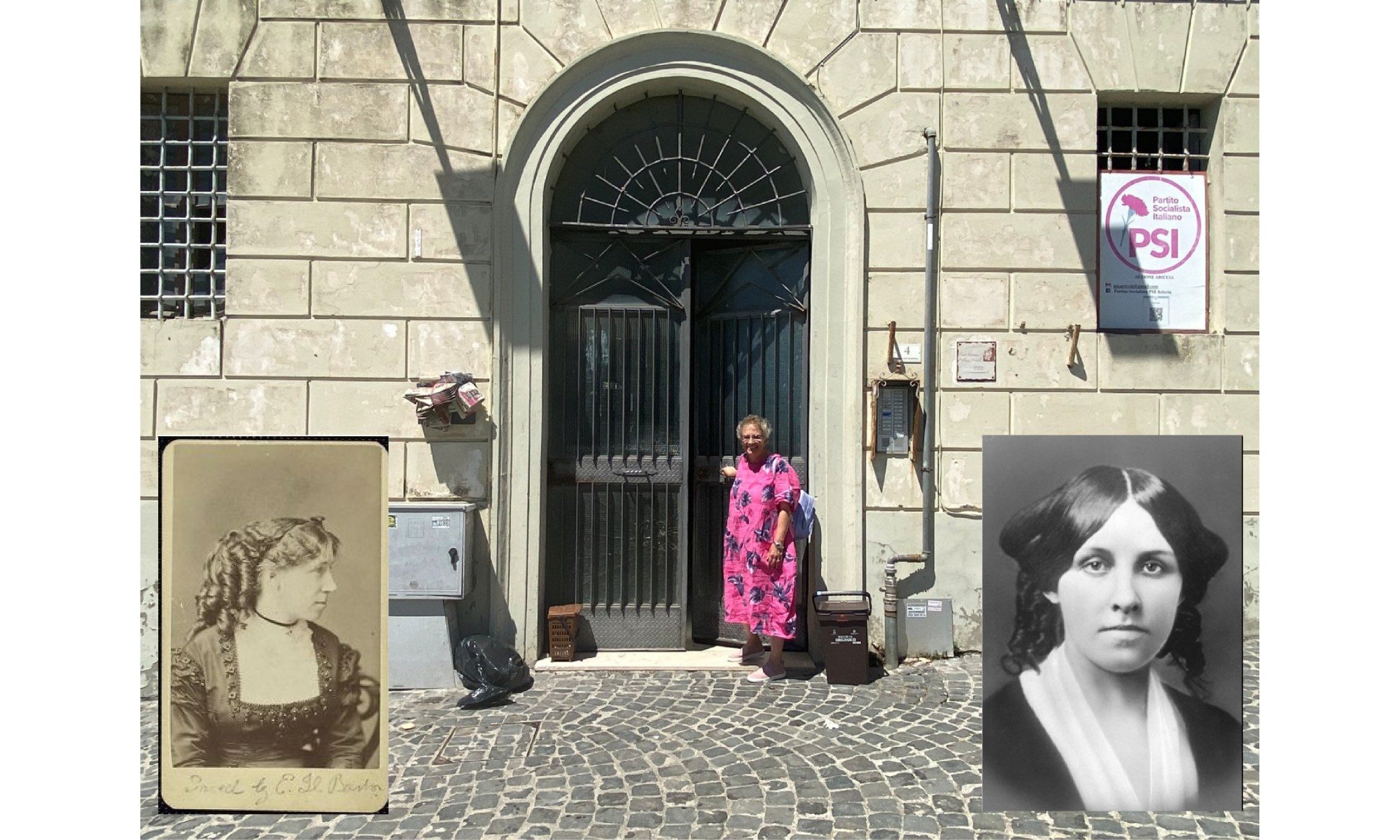
Guest post by Lorraine Tosiello
In March 1871, toward the end of their Grand Tour in Europe, Louisa May Alcott, her sister May, and May’s friend Alice Bartlett were ready to quit Rome. Alcott had suffered from neuralgia during a rainy winter and had seen the Eternal City through blue glasses. Her dislike of nobility, Papal authority, dismal weather, and the general state of mold and dust had not endeared Rome to her fancy. In her travelogue, Shawl Straps, Louisa writes that “Lavina” (herself, thinly veiled) “proposed to flee to the mountains before they became quite demoralized.[1]” And flee they did to the hill town of Lazio Albano, south of the city, for a respite.
The cool springtime in the “Castelli Romani” (the collection of small hill towns bordering natural volcanic lakes about 15 kilometers south of Rome) revived Alcott mentally and physically. It was here that she completed Little Men and wrote some sweet episodes of adventures in these secluded hills for her serial Shawl Straps.
I had the tremendous fortune to spend two days tracing the footsteps of Alcott in the charming Colli Albani. My friend and guide, Laura Piersanti, lives in Albano Laziale, the very town where our travelers stayed. Using Shawl Straps and a new Italian text, Louisa May Alcott ai Colli Albani by Stefano Paolucci, she enthusiastically mapped a course to every site with evidence of an Alcott sisters’ visit.
Albano Laziale
The Alcott entourage traveled by train from the uncompleted new Roman station, the Termini. Today, the chaotic train station quickly ceded to the green hills south of the city, dotted with picturesque ruins and small sections of long destroyed aqueducts. The same train line was present in 1871, so it is easy to imagine the similar view the travelers enjoyed. Alcott wrote of the Albano train station that “two miles of mud lay between her and home,”[2] and Harriet Hosmer, the reigning American woman sculptor in Rome, wrote about “Old Giovanni, the donkey guide” who met travelers at the Alban gate. [3] Whatever the mode of transportation, the women were given sanctuary in Albano’s comfortable “breezy rooms,” although it is unknown where.[4] They may have lodged in one of the stuccoed buildings dating from before 1871 that line the main street. The type of accommodations the three likely stayed in can be surmised from the photo of Albano Laziale.


A famous stop on the Grand Tour during the mid-nineteenth century was a well-preserved inn in the adjacent town, which adds to our understanding of tourist accommodations from that era. The Locanda Martorelli stands as a reminder of the type of inn the Alcotts likely inhabited; a restaurant would have occupied the ground floor, ornately decorated salons on the second, and sleeping rooms on the third to fifth floors. Nathaniel Hawthorne, the Alcotts’ Concord neighbor, was a guest at the Locanda Martorelli.

Regardless of where they lodged, the women spent their days tramping the region between Lake Albano and Lake Nemi, enjoying the views of the magnificent modern viaduct joining the towns of Albano and Ariccia from the valley below or the viewing point along the upper village, and visiting the ancient Roman Tomb of the Orazii and Curiazi, which Louisa recalled as the “ ‘Tomb of the Four Thimbles,’ as Livy irreverently called the ruin, which has an ornament at each of its corners like a gigantic thimble of stone.” [5] Today, the site is more overrun with vegetation than it was in 1870, as a photo of the tomb as it would have appeared in Alcott’s time attests.
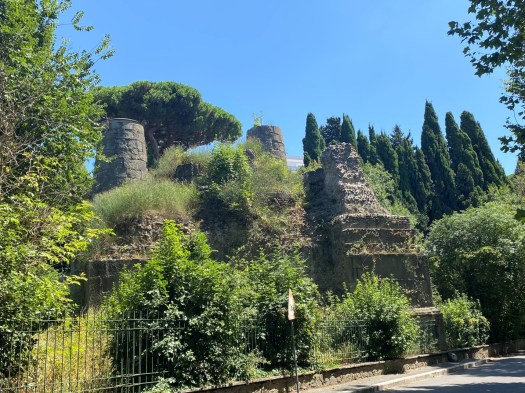 “Tomb of the Four Thimbles”

Ariccia
Ariccia, along with the stunning viaduct connecting it to Albano Laziale, is the scene of an amusing story in Shawl Straps. May and Alice, eschewing the span of the viaduct, hiked down and then up the small but deep valley between the two towns. Arriving in Ariccia, they unknowingly entered the private grounds of an attractive but decaying villa. There, a young man gazed down at them from a high balcony and invited the young ladies in to tour the home, offering to let some rooms to them. May and Alice commented that the children in the nursery had a remarkable resemblance to Napoleon I. Their host responded, “Truly yes : we belong to the family. My mother is a Buonaparte, my father Count ____.”[6] Thanks to historian Stefano Paolucci, it is here that we can now identify the unnamed Count and his family. Using this clue about the Bonaparte family connection and the geographic reference that the building could be accessed from both the park and the street level, Paolucci has pinpointed the exact building—the Palazzo Bonaparte-Primoli.[7] The family living there in 1871 were Carlotta Bonaparte (granddaughter of Napoleon’s brother Luciano) and her husband, Pietro Primoli. The oldest of their three sons, Guiseppe Primoli, who later became a photographer, was the young man who welcomed the Americans.[8]
May and Alice rushed home to fetch Louisa to see the rooms. They escorted “the griffin” over the viaduct and along the street side of the palazzo” through the dirty little town, by the villa on its least attractive side.”[9] Louisa “put a wet blanket on the entire plan by declaring that she would never board with any grasping old patrician”[10] and did not enter the building but looked in through the gate before returning home past the Tomb of the Four Thimbles.
I traced those same steps over the viaduct (concurrent with the Via Appia Nuova) past the magnificent Bernini church, turned right on Corso Guiseppe Garibaldi, and arrived at the street entrance to the Palazzo Primoli. Today, it is an apartment building with bed and breakfast rooms available as well. As luck would have it, the entrance was open, and I display here the entrance, the entry lobby, and the balcony, which is, in all likelihood, where the young man spied the American ladies in his garden.


You can still find the gardens by skirting around the back of the building. They are now public gardens, and a modern path (likely on the route of the same one that May and Alice took on their walk that day) winds down to the base of the viaduct. Descending in the spirit of the travelers, inspired by the romantic story of the Bonaparte family, was thrilling!


Although Louisa gave the town less than a stellar review, I offer some photos of its impressive artistic legacy: Santa Maria Assunta, designed by Bernini, and the magnificent Chigi Palace.
In Part 2, we will follow more geographical clues to pinpoint the locales where the Alcott travelers enjoyed their days in the Castelli Romani.
References
Alcott, LM. Shawl Straps, Volume 2, Roberts Brothers, Boston 1872.
Paolucci, S. Louisa May Alcott ai Colli Albani, Passamonte Editore, Grottaferrata 2020.
All images are my own, except for the image of the Tomb of the Four Thimbles, which is open content shared from Wikimapia.
All quotes from Paolucci are translated from Italian to English by myself.
[1] Alcott, LMA. Shawl Straps, Volume 2, Roberts Brothers, Boston 1872. p. 176.
[2] Alcott, ibid. p. 185.
[3] Carr, C. Harriet Hosmer Letters and Memories, Moffat, Yard & Co., New York 1912. p. 107-8.
[4] Alcott, ibid. p. 178.
[5] Alcott, ibid. p.182
[6] Alcott, ibid P. 179
[7] Paolucci, S. Louisa May Alcott ai Colli Albani, Passamonte Editore, Grottaferrata 2020, p. 18.
[8] Paolucci, ibid, p.20.
[9] Alcott, ibid, p.181.
[10] Alcott, ibid, p. 181.
 Are you passionate about
Louisa May Alcott too?
Subscribe to the email list and
never miss a post!
Facebook • Instagram • Twitter
 Find Susan’s books here on Amazon
 Louisa May Alcott is My Passion
This was a fascinating article! Thank you!
What a wonderful pilgrimage. Thanks so much for sharing your journey!