

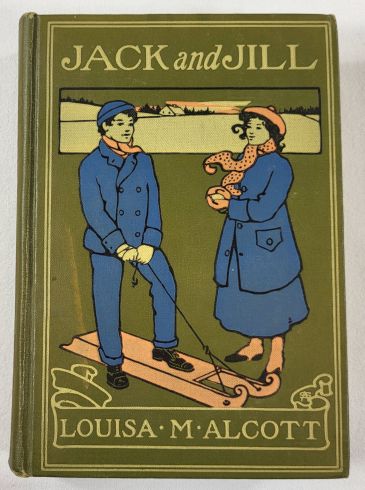
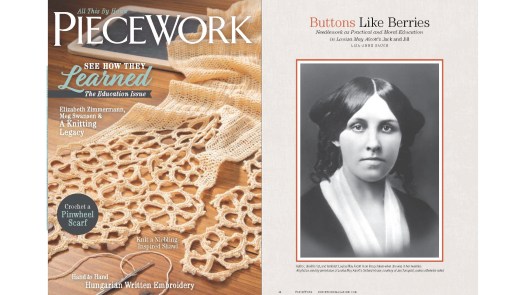
 I am indebted to my good friend Virginia Martin for alerting me to the latest issue of “Piecework” and the wonderful article by Lisa-Anne Bauch about Louisa May Alcott’s needlework and its connection to one of her later juvenile novels, Jack and Jill.
Bauch summarizes the plot and weaves Louisa’s use of needlework to flesh out her characters.
Cathlin Davis, PhD, an expert on Louisa’s writings, and Jan Turnquist, Executive Director of Louisa May Alcott’s Orchard House, contributed to the article.
Turnquist remarked on Louisa’s needlework skill and her beautiful creations. She marveled at the fact that workaholic author could find the time. My guess is that she spun stories as she sewed, and found the work to be therapeutic and restful. Anna reflected in her 1861 journal on the benefits she experienced from the activity”
I spent the afternoon as usual in sewing, that never failing service of womankind the world over, & a blessed invention for quieting troubled nerves, & easing the heartache, for I think poor woman often sews away many pains & troubles of both the body & mind, stitch stitch stitch being a gentle tranquilizer.” (Thursday, March 14, 1861 from Ray Angelo’s annotated transcription)
Lizzie too found sewing to be her saving grace during the last months of her life, finding purpose in the work, and enjoyment in sharing her trinkets with the schoolchildren passing under her window at Bedford Street.
Here is the article in its entirety.
Click to access piecework-article-on-jack-and-jilll.pdf
.
 Are you passionate about
Louisa May Alcott too?
Subscribe to the email list and
never miss a post!
Facebook • Instagram • Twitter


 Louisa May Alcott is My Passion
JACK AND JILL is one of my favorite Alcotts; thanks for posting the article. My mom used to tat like Jill–I remember the steady snick-snick-snick of the metal tatting needle.
What a nice memory!
😍
Thanks so much for sharing this! I thoroughly loved reading Alcott’s Jack and Jill, and enjoyed how this article explained a bit more than I originally took away from the book.
I had never read the book and now I want to! 🙂
Let me know what you think about it, it certainly shows a different way of life, a lovely way of life.
I will!
Just been reading & re-reading Louisa’s Memoirs & have been amazed at how much time & skill she spent in making clothes, ties, sheets, etc., either to provide income for her family or to make pretty things for her sisters, Lulu, or friends, etc.
What an unbelievably accomplished woman, and what a workaholic.
I believe she literally worked herself to death to make life better for her family, (&, as a very poignant letter to her written by May states-which Mr. Shealy revealed in his section of “The Forgotten Alcott”), I believe May did too.
Best Regards-Alex
Louisa was definitely a workaholic, partially because it was ingrained in her because of the family’s poverty. But I also think it was in her DNA. She couldn’t stop her mind from working. And yes, I agree completely that overwork played a part in her poor health. May, on the other hand, led a much more balanced life.
Thank you Susan!!
I totally agree.
What I was also referring to was I thought an incredibly intelligent and mature letter, revealed in Mr. Shealy’s chapter of “The Forgotten Alcott” written by May to Louisa where she stated
,”Certainly Dear Lu you can never be grateful enough that you have been the one to make dear Marmee and Papa too so comfortable and happy these last years by your generosity and devotion, for money has done what affection alone could never do…and you have delighted in making us all happy in our own way tho’ much of your own life and health have been sacrificed in doing it, and I feel this perhaps more than anybody.”
I also thought in re-reading Louisa’s journals that it was amazing and touching that the bond & love between Lu & May continued to grow and deepen with the passage of time.
Thanks for everything Susan.
Best Regards-Alex