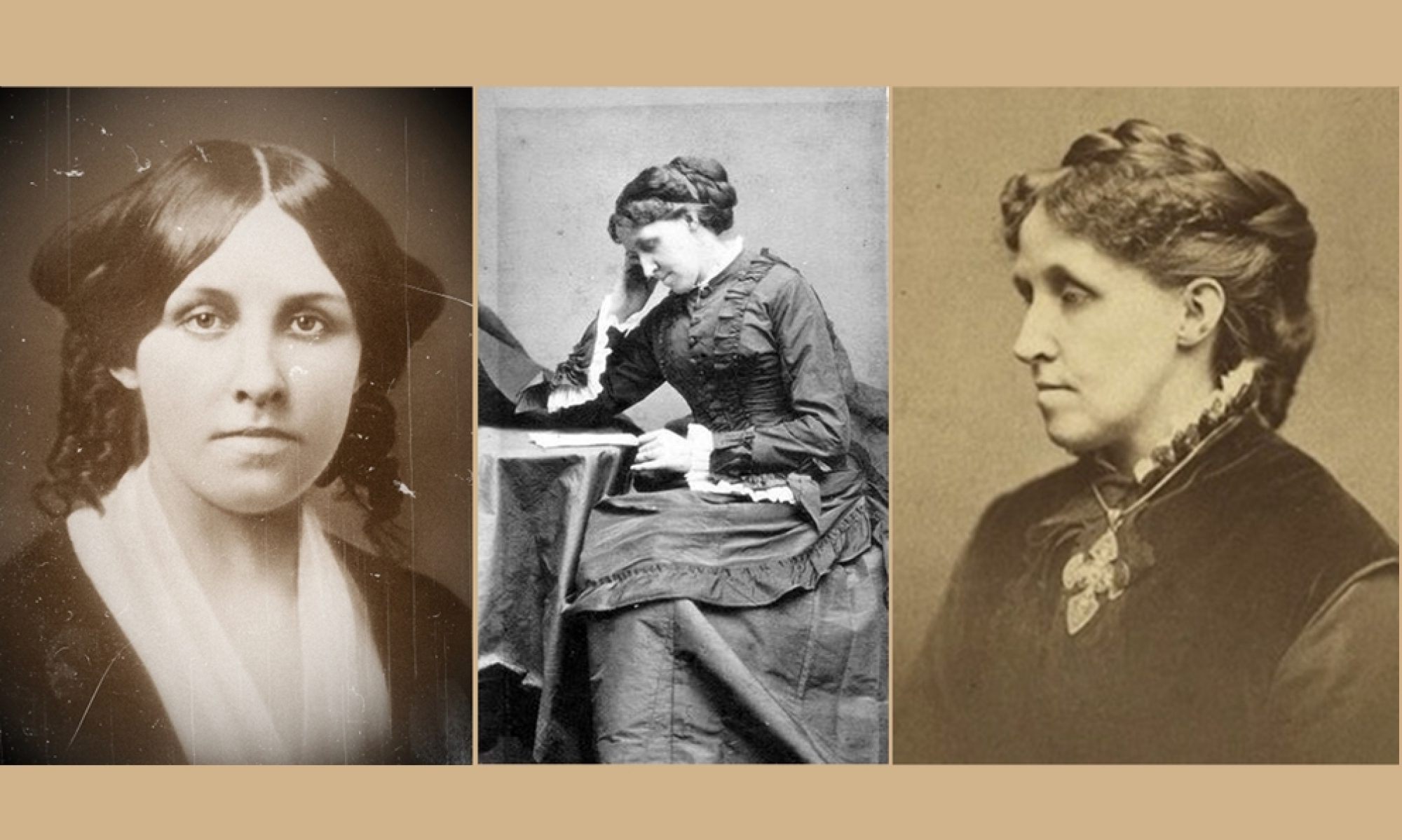
Six women writers (including Louisa May Alcott) and their journeys as writers on film

There is a wonderful film online featuring the stories of six prominent women writers (including Louisa May Alcott, of course!. It is called Behind a Mask: Six Women Finding a Space to Write. Here is the summary from the website, Films on Demand Digital Educational Video:

Behind a Mask: Six Women Finding a Space to Write

This program explores the obstacles overcome by six prominent female authors: Louisa May Alcott, Emily Dickinson, Charlotte Perkins Gilman, Virginia Woolf, Sylvia Plath, and Alice Walker. On-location footage at sites such as Alcott’s Orchard House in Concord, Massachusetts, complements discussion from an array of critics and experts, including Dr. Carolyn Heilbrun, author of Writing a Woman’s Life; Professor Elaine Showalter of Princeton University; Dr. Sarah Elbert, author of A Hunger for Home: Louisa May Alcott’s Place in American Culture; Madeleine Stern, Alcott’s biographer and editor; and Dr. Leona Rostenberg, who, together with Stern, proved that Alcott wrote many sensationalist stories under a pseudonym. Produced by the Open University. (50 minutes)

You can watch the film in its entirety here.

This is a breakdown of the film from Films on Demand:

Women Struggle to Write (04:19) 
Until the mid-twentieth century, women writers such as Louisa May Alcott, Charlotte Bronte, and Jane Austin had to negotiate and justify their desire to write.

Louisa May Alcott (04:39) 
Alcott recreates her life with her three sisters and mother in “Little Women” depicting the hopes and dreams of a house full of females. She negotiates mental and physical space to write her novel.

Emily Dickinson (04:08) 
Dickinson created a reclusive space to write exquisite poetry reflecting women’s culture and women’s inner life. Hundreds of unconventional poems are published posthumously.

Alcott’s Sensation Stories (02:24) 
In the 1970s fascinating research by Stern and Rostenberg discovered Alcott’s sensation stories. Clues in “Little Women” reveal the writing activities of Jo March that parallels Alcott’s life.

Discovery of Letters and Pseudonym (04:13) 
Researchers discover letters to Alcott approving the publication of “Behind the Mask” and evidence of her pseudonym, A.M. Barnard. Alcott’s work is autobiographical and controversial.

Charlotte Perkins Gilman (04:59) 
“The Yellow Wallpaper” by Gilman is about a woman’s stifled creativity and the development of madness from domestic confinement. Gilman escapes her marriage through divorce.

Gilman Inspires Other Women (03:09) 
In the 1890s yellow represented decadence. The woman in “The Yellow Wallpaper” becomes obsessed and lost in it. Gilman continues to inspire women with further political works and feminism.

Virgina Woolf (04:20) 
In Woolf’s “A Room of One’s Own,” she states that a woman must have money and a room of her own if she is to write fiction. She was a prodigious writer of essays, short stories, and novels.

Sylvia Plath (06:21) 
American writer Sylvia Plath greatly admired Virginia Woolf. In “The Bell Jar” and “Lady Lazarus,” she expresses madness as rage. Like Gilman and Woolf, Plath plans and commits suicide.

Alice Walker (02:04) 
Black women writers have had to deal with issues of gender, race, and class in ways that are not central to white women’s literature or men’s literature. Black tradition influences Alice Walker.

“The Color Purple” (04:09) 
“The Color Purple” is what Walker would call a “womanist” novel including issues of eroticism and a struggle missing from white feminism. Walker gives Celie space through her letters.

Quilting (04:02) 
Walker’s use of quilting is found in “The Color Purple” through the characters in both fragment and form. “Sister’s Choice” is a type of quilt that is a metaphor for the differences of women’s lives.

Watch the entire film here.

Click to Tweet & ShareSix women writers (including Louisa May Alcott) and their journeys as writers on film http://wp.me/p125Rp-1sQ

Are you passionate about Louisa May Alcott too?
Send an email to louisamayalcottismypassion@gmail.com
to subscribe, and never miss a post!
Facebook Louisa May Alcott is My Passion
More About Louisa on Twitter

Susan’s ebook, “Game Changer” is now available From the Garret – download for free!

Questions, questions … (part two) – turning to May

How did May Alcott get away with so much?

In 1868, she joined her sister Louisa in Boston to teach an art class. Louisa had just secured her position as editor of Merry’s Museum. She was 35 and May, 27.

Line of intrigue

Madeleine Stern wrote a rather intriguing line about May that sparked the above question:

May joined her to start a drawing class and gave every promise of abandoning her wild oats and settling down into a sober teacher of the art in which she was completely engrossed. (pg. 164, Louisa May Alcott A Biography by Madeleine Stern).

The bold is my emphasis.

Not so young, and free

May was 27, single, sowing her wild oats. She was free. How did she get away with it considering the many restrictions on women in the 19th century?

Acceptable for a woman

Was it because she pursued an interest that was considered acceptable? After all, many a fine lady took up drawing. In chapter 12 of Little Women, “Camp Lawrence,” Miss Kate, the fine (and snobby) Englishwoman is depicted as an artist.

The baby of the family

Was it because she was the youngest daughter that she managed to fly under the radar and avoid the responsibilities that Louisa and Anna had taken on with such gusto?

Attitude on life

Was it because May was blessed with that certain “joie de vivre” that made her appear younger than she was?

Oh so charming

Was it her expertise in the art of graciousness that could charm anyone?

What was it?

Your thoughts …

Click to Tweet & Share: May Alcott is 27, unmarried, unfettered, following her dream. How did she get away with it in 19th century NE? http://wp.me/p125Rp-197

Are you passionate about Louisa May Alcott too?
Send an email to louisamayalcottismypassion@gmail.com
to subscribe, and never miss a post!
Facebook Louisa May Alcott is My Passion
More About Louisa on Twitter

Susan’s ebook, “Game Changer” is now available From the Garret – download for free!

My 3 days with Louisa May Alcott (part four): connections between Louisa May Alcott and Margaret Fuller

Note: This post is longer than usual. I had considered running it in two installments but thought it would lessen the impact of its message by doing that.

So sit back with a cup of coffee, relax and read. :-)

Two ladies,
same vision

Two New England feminists, both heavily influenced by transcendentalism.

Both in the company of Ralph Waldo Emerson, Henry David Thoreau and Bronson Alcott.

Both very reform-minded.

Both would forever change history for women.

Louisa May Alcott and Margaret Fuller were neither friends nor colleagues yet they shared a similar passion for women’s rights, believing it was best for society.

Continuing with the theme of yesterday’s post, Pulitzer prize-winning author John Matteson drew connections between these two women while highlighting their different approaches.

What was Margaret Fuller’s vision for women?

Margaret Fuller, much like Bronson, believed in attaining spiritual perfection. She was the most passionate of the transcendentalists, that passion often spilling over to the individuals themselves.

Much more than a flirt …

Hester Prynne from The Scarlet Letter by Nathaniel Hawthorne

It is titillating to read about her intense relationships with Emerson and Nathaniel Hawthorne (not a transcendentalist, but he did base the heroine of The Scarlett Letter on Margaret – see Wikipedia on Margaret Fuller) but it is also distracting. Margaret may have been a flirt but she was brilliant.

Living her words

A woman’s voice was needed in the Transcendentalist movement and she brought it. While Bronson and Emerson talked a great game regarding the value and worth of women, Margaret lived it, educating women through her writing and her brand of “conversations.”

The vision laid out

Women in the Nineteen Century is Margaret’s tour de force, where she lays out her vision for women.

Matteson laid out Margaret’s demand for full rights for women, well beyond the political and economic; this would include equality spiritually and intellectually.

Bringing virtue to the marketplace

A reformer at heart, she believed that women needed to be in marketplace in order to bring about reform. Taking the traditional role of the wife leading the husband to greater virtue, she extends it out to the greater society: women in business would lead the marketplace (and the men in it) to greater virtue.

Man versus Men, Woman versus Women

Margaret was a philosopher greatly influenced by Transcendentalism. She, like Bronson Alcott, believed in attaining spiritual perfection. Part of that perfection involved gender. Daily reality had placed men and women in narrow roles and neither gender was free because of what she called, “debased living.”

Note that the original title of Women in the Nineteenth Century had been “The Great Lawsuit: Man versus Men, Woman versus Women”; it was originally a series of essays serialized in The Dial, the Transcendentalist magazine that Margaret edited for Ralph Waldo Emerson.

Effects on marriage

The distortion of the genders in turn, warped the institution of marriage Margaret believed that the dependency of women on men had debased marriage and sex. She remained single for several years until she had a child with Italian revolutionary Giovanni Angelo Ossoli, a marquis who had been disinherited by his family. While it is assumed they were married but there is no hard evidence that they did (source: Wikipedia).

Lead by deeds

Placing reform above all else, Margaret felt that women did not necessarily need to rule but to lead by example. In order to do that, it was imperative not to impede the soul. Each man and woman had to be free to realize their full potential, be who they were meant to be.

Benefits to society

This freedom, however, was not meant just to satisfy individual wants. Here Margaret led by example. She denounced not only the treatment of women but African and Native Americans as well. She advocated for reform in prisons, visiting women in Sing Sing in October of 1844 and even staying overnight (source: Wikipedia). She raised concerns for the homeless, especially in New York (Ibid).

On the same page

If you are familiar with Louisa’s beliefs on women and reform, you can see in similarities already between the two women from Matteson’s description of Margaret’s vision.

Louisa’s vision for women and society

Spiritual father …

Louisa came from one of the founders of Transcendentalism, Bronson Alcott. He was all about spirituality, perfection and becoming divine.

… and reformer mother

But she also came from her mother Abba, a pragmatic reformer. Unlike her philosophical husband whose head was in the clouds, Abba practiced her Christianity day to day, often giving to others out of her family’s own want (Bronson practiced this also, believing that God would always provide).

Bronson exuded serenity as he sought to perfect himself. Abba passionately wrestled with life and others to bring forth reform. Her most noteworthy efforts were in Boston in the 1840s as one of the first social workers.

Societal change needed

Coming from such a background, it is no wonder that Louisa felt that society must be reordered. It began with freeing the slaves.

Belief coming from experience

Matteson noted an incident when Louisa was 3 which most likely opened her eyes to African Americans as equals. While living in Boston, she fell into the Frog Pond; she was rescued by a black boy. She notes in her writings that this boy lit the flame of abolition in her heart.

Living out that belief

Throughout her life, Louisa helped her parents shield and transport runaway slaves to Canada; their home in Concord, known then as Hillside, was on the underground railroad.

Illustration by Flora Smith for The Story of Louisa May Alcott by Joan Howard.

With pride, Louisa notes that she served tea to John Brown’s widow at Orchard House.

An rare open statement

Louisa didn’t usually state her feminist views blatantly in her fiction writing. One exception was Hospital Sketches where she writes, “I’m a woman’s rights woman, and if any man had offered help in the morning, I should have condescendingly refused it, sure that I could do everything as well, if not better, myself.” (from Chapter 1, Hospital Sketches)

Another was a short story, “Happy Women.” This excerpt explains in a nutshell Louisa’s vision for womanly happiness:

This class is composed of superior women who, from various causes, remain single, and devote themselves to some earnest work; espousing philanthropy, art, literature, music, medicine, or whatever task taste, necessity, or chance suggests, and remaining as faithful to and as happy in their choice as married women with husbands and homes.

Subterfuge in her writing

Most of the time she teased out her views in her writing. She would describe the lives of purposeful women who earned their keep and remained independent. Matteson described the importance of work to Louisa saying that life was full of work that needs to be done, and it needs to be done by both sexes.

Becoming the best she can be

Louisa believed as did Margaret that women needed to develop themselves for if a woman developed her talent fully and used it for others, she would be happy. And just as Margaret led by example, so did Louisa, becoming a best-selling author.

Using her bully pulpit

In that position, Louisa could wield a lot of influence and she took every advantage to use it. While Jo March is often cited as the best example of an independent woman, Matteson used the example of Polly from An Old-Fashioned Girl who takes her well-off, bored and disgruntled friend Fanny to visit her sisterhood of working, purpose-filled women. Fanny’s life is changed forever after seeing that life could be so much more than the emptiness of parties and fashion.

Giving your best

Louisa was also greatly valued sacrifice. Like Margaret, a woman’s right to reach her potential was not just for herself; she was to give her best to those around her. This belief plays out again and again in her books.

Duty’s faithful child

Bronson distrusted Louisa’s selfless intentions until she became a nurse. When he saw how she was willing to give up her own life for others by nursing, he wrote his famous sonnet to her, “Duty’s Faithful Child.”

Using her right to vote

Matteson ended his lively presentation with an ironic anecdote. Noting that Louisa was the first woman to register and then to vote in Concord, he quipped that the registrar gave her a literacy test! She also was required to sign her name to prove she could write.

It was the one time in her life that she was in a hurry to pay her taxes so she could qualify. :-)

Click to Tweet & Share: Two ladies who would change the lives of women forever: Louisa May Alcott and Margaret Fuller http://wp.me/p125Rp-16Q

Are you passionate about Louisa May Alcott too?
Send an email to louisamayalcottismypassion@gmail.com
to subscribe, and never miss a post!
Facebook Louisa May Alcott is My Passion
More About Louisa on Twitter

Susan’s ebook, “Game Changer” is now available From the Garret – download for free!

My 3 days with Louisa May Alcott (part three): John Matteson talks about his two favorite ladies

Pulitzer prize-winning author John Matteson

This was the day I was waiting for.

Ever since I started reading Eden’s Outcasts: The Story of Louisa May Alcott and Her Father, I have been dying to talk to John Matteson.

His penetrating insights into Bronson and Louisa have forever changed the way I look at them (most especially Bronson).

Unique understanding

In my opinion, he is the only biographer I’ve read who commands an understanding of spirituality, a necessary part of the puzzle when analyzing the life of the complex, often exasperating Bronson Alcott.

Matteson has referred to Bronson as a mystic. Mystics often teeter between sanity and madness; Bronson certainly fit that description.

The Lives of Margaret Fuller

Since writing Eden’s Outcasts, Matteson has released a new book called The Lives of Margaret Fuller.

Brilliant mind

Fuller, probably the most intellectually brilliant of the transcendentalists, has largely been ignored. Yet her treatise on women’s rights, Woman in the Nineteenth Century, inspired many feminists including Susan B. Anthony. Fuller’s book was the first major feminist work in the United States (source: Wikipedia).

First foreign correspondent

Matteson mentioned that Fuller, in spending her final years in Italy, was not only the first female foreign correspondent for a newspaper, she was the first foreign correspondent, period.

Links between Louisa May Alcott and Margaret Fuller

He thus used his lively presentation to discuss his two favorite ladies, Louisa and Margaret, and the ties between them.

Not necessarily colleagues

Louisa and Margaret didn’t actually know each other. Twenty-two years her senior, Fuller had left Concord by the time Louisa was twelve.

First meeting

But they had met. There is a bit of lore from Eden’s Outcasts about the first meeting between the two in 1840 when Fuller was introduced to Bronson’s “model children.”

illustration by Flora Smith for The Story of Louisa May Alcott by Joan Howard

As the introduction was about to take place, those children came racing to the front of the house in active play. Louisa, acting the part of the horse, pulled the wagon carrying Anna (the proper young lady), Lizzie (the dog, barking as loudly as her little voice would allow) and baby Abby May. Upon seeing their father with Margaret, Louisa stubbed her toe and fell, dumping all the occupants out of the wagon. Much laughter ensued amongst the tangle of legs. Louisa’s mother Abba grandly announced, “Here are the model children, Miss Fuller!” (Eden’s Outcasts, page 209, ebook)

Similar ideas through different approaches

Louisa and Margaret may not have been friends or colleagues but they both had similar ideas about the right of a woman to determine her own destiny, and how this would benefit the greater community. Where they differed was in their approach. Margaret the philosopher favored cultivating oneself while Louisa the pragmatist, emphasized service. She believed a woman could still fulfill her duty while cultivating her intellect.

Louisa praises housework

Providing a simple illustration, Matteson cited a letter Louisa had written in which she lauds housework as a great opportunity to think on and discuss high-minded topics. She herself often “simmered stories” while fulfilling her domestic duties.

Their vision of women’s rights

Both women agreed that women’s rights were not necessarily for the individual but for the community. It was deeper than gaining economic opportunities (although such opportunities certainly facilitated independence).

Complex fathers

Amos Bronson Alcott

Louisa and Margaret were also alike in the kind of support (or lack of) that they received from their fathers. Both women received a rich education from their fathers and were consistently encouraged to use it.

Both women also had fathers who were poor providers.

Persistent poverty and its consequences

Bronson’s lack of ability (some say desire) to provide financially for his family is legendary. He was incapable and unwilling to work for a living wage and the family was destitute for years.

Matteson remarked that the constant poverty gave Louisa a “depression-era mindset” where she obsessed over money, counting every penny. She overworked herself with constant writing long after the fame and fortune that came from Little Women.

Humiliation through dependence

In Margaret’s case, it was a father who reneged on his responsibility to secure a will before he died. This left Margaret, her mother and her siblings at the mercy of her father’s brothers who took control of the property and finances, forcing Margaret and her family into the humiliating position of being dependent on them. Inevitably these legal problems deprived her of educational opportunities.

Rising above their circumstances

Despite these difficulties both women fought for a better life for themselves, their families and most especially for society. The education so generously bestowed on them by their fathers bore its fruit through the written (and in Margaret’s case, also the spoken) word. Theirs was a message of women’s rights, autonomy, and reform.

In the next post, I will detail Margaret and Louisa’s vision for women and the benefit to society as laid out by John Matteson in his presentation.

Click to Tweet & Share: How are LMA and Margaret Fuller connected? Biographer John Matteson knows both women intimately and discusses how. http://wp.me/p125Rp-15W

Are you passionate about Louisa May Alcott too?
Send an email to louisamayalcottismypassion@gmail.com
to subscribe, and never miss a post!
Facebook Louisa May Alcott is My Passion
More About Louisa on Twitter

Susan’s ebook, “Game Changer” is now available From the Garret – download for free!

Work: “Tinker, tailor, soldier, sailor” – what could women do?

Illustration by Flora Smith, The Story of Louisa May Alcott by Joan Howard

You’ve come of age and it’s time to strike out on your own.

How do you feel?

  • Excited?
  • Fearful?
  • Full of anticipation?

Will it be a grand adventure or a dismal failure?

In her mid-twenties, Louisa May Alcott was ready to strike out on her own, fueled by her obsessive desire to be a financial support to her habitually poor family.

What occupations could a twenty-something genteel woman aspire to?

In Work A Story of Experience, chapters 1-6 reveal through Christie Devon how such a woman could be gainfully employed:

  • Domestic servant
  • Actress
  • Governess
  • Companion
  • Seamstress

Throughout her twenties until she could make her writing pay, Louisa was employed in these various occupations. She pointedly left out two others: factory work and teaching, the former because she felt it was beneath her and the latter because she hated it.

As Louisa was fond of morality plays, Christie experiences a testing of her soul in each occupation:

Servant

As a domestic servant, Christy learns a lesson in humility from her co-worker, a runaway slave named Hepsey.

Lesson in perspective

When asked to blacken her master’s boots (deemed to be the lowliest of tasks), Christie protests, considering the task to be degrading. Hepsey, however, offers to do the job for Christie as she considers any job that paid worth doing if she could earn the money she needed to buy her mother out of slavery.

Christie immediately feels chastened as her small humiliation is put into perspective.

Real life connection

Louisa went out to service when she was seventeen and when she refused the overtures of her master, was given all the hard work plus the task of blackening his boots. She quit in a huff.

Chronicled in her short story, “How I Went Out to Service,” it proved to be one of the most humiliating experiences of her life. Usually able to dismiss such experiences with sarcastic humor, this was one time when her humor failed her.

Actress

Christie is cajoled by a friend to try acting. At first she resists the suggestion because acting is not considered a proper occupation for a genteel woman. Tales of glamor and glory and the adventure of it all persuade Christie to give it a whirl, and in the end, she makes a good living at it over the next three years.

Soul searching

Christie enjoys the applause of the audience and the praise of her co-workers but finds herself changing into someone she no longer recognizes. Hard, shallow and vain, Christie takes a hard look at herself and decides to walk away:

“Others might lead that life of alternate excitement and hard work unharmed, but she could not. The very ardor and insight which gave power to the actress made that mimic life unsatisfactory to the woman …”

Louisa’s love of acting

I found this particular section quite revealing about Louisa. She of course aspired to be an actress, wanting to be famous like Fanny Kemble or Jenny Lind. She and older sister Anna immersed themselves in theatricals, from entertaining the family through hard times to performing with acting troupes in Walpole, NH and Concord. It was the only occupation apart from writing that held any allure.

Not the right career choice

Louisa was a good character actress and comedienne; it proved to be a great way to vent her creative energy. She eventually dismissed acting as a career choice, partially because it was not considered respectable. But it’s obvious a lot of soul-searching went on as evidenced by Christie’s self-examination; Louisa felt acting would lead to a life she could not abide by:

“After being on the stage & seeing more nearly the tinsel & brass of actor life (much as I should love to be a great star if I could), I have come to the conclusion that its not worth trying for at the expense of health & peace of mind.” (pg. 149 ebook, Louisa May Alcott The Woman Behind Little Women by Harriet Reisen)

The better moral choice

Having been schooled in morality relentlessly since her birth (and reminded over and over how selfish she could be), Louisa could not justify the vanity and self-absorption that came with the pleasure of acting. Writing was morally more acceptable.

cover of Louisa May: A Modern Biography of Louisa May Alcott by Martha Saxon

Ironies

It is ironic, however, that she could justify secretly indulging in lurid blood and thunder tales (using the name of A M Barnard) under the guise of making money.

Perhaps because the indulgence was temporary, ending with the story’s conclusion, she could do it without totally selling out her soul. With acting, Louisa feared losing herself entirely in the bargain.

In the next post, I will examine the other occupations, most especially the role of companion, for this chapter revealed a deep fear that haunted Louisa throughout her life.

Click here to read part one of this series on Work.

.
2012 Summer reading challenge hosted at www.inthebookcase.blogspot.comReading Work  by Louisa May Alcott is part of my Louisa May Alcott Summer Challenge - are you a part of this challenge and if so, how are you doing?


Click to Tweet and share:
Work: striking out on your own as 19th century woman – Louisa’s perils and pitfalls http://wp.me/p125Rp-14q

Are you passionate about Louisa May Alcott too?
Send an email to louisamayalcottismypassion@gmail.com
to subscribe, and never miss a post!
Facebook Louisa May Alcott is My Passion
More About Louisa on Twitter

Susan’s ebook, “Game Changer” is now available From the Garret – download for free!

The boys in Louisa May Alcott’s life

From the pages of Aunt Jo’s Scrap-Bag comes an intriguing memoir of the boys in Louisa May Alcott’s life, “My Boys.”

From one “boy” to another

Louisa had always preferred the company of boys and wished she had been born one herself.  She particularly favored the age when boys were “regarded as nuisances till they are twenty-one.” Enjoying the rough and raw edges of adolescent boys, she writes:

“I like boys and oysters raw; so, though good manners are always pleasing, I don’t mind the rough outside burr which repels most people, and perhaps that is the reason why the burrs open and let me see the soft lining and taste the sweet nut hidden inside.”

Finding acceptance

Louisa herself was certainly rough and raw and found acceptance with boys that age that she didn’t find with her own peers. Her manner was considered “queer” (her word) by most who felt she didn’t fit the mold of a Victorian woman but boys readily embraced her queerness. In Louisa, they found a friend and intimate confidant who embraced and accepted them. It was a way of accepting herself.

Fact or fiction?

“My Boys” was written after Little Women and probably needs to be taken with a grain of salt. There is no way of verifying the facts. However, the story reveals a warm and bighearted woman who, despite her desire to remain single, did on occasion, require the intimacy of a close friendship.

Let’s meet some of the boys in Louisa May Alcott’s life:

drawing by Flora Smith, from The Story of Louisa May Alcott by Joan Howard

Frank

Frank was Louisa’s first “well-beloved” boy. Meeting him at the age of seven, he became her constant playmate. He insisted on testing her mettle with a bit of bullying, trying his best to make her cry “by slapping my hands with books, hoop-sticks, shoes, anything that came along capable of giving a good stinging blow.” It was with great pride that Louisa did not, and he respected her for it: “‘She’s a brave little thing, and you can’t make her cry.”

Beginning with Frank, Louisa competed with any boy who was up to the challenge. She prided herself with being able to drive a hoop as tall as she around the Boston Common better than any boy.

Frank ultimately broke her little heart through betrayal, breaking up the friendship. Yet despite the pain, Louisa remembered him fondly in the story.

Christy

Here was a boy in whom Louisa could place her confidence. She met Christy while visiting relatives away from home and found him to be a tremendous source of solace. Punished by the matron for being naughty, she is banished to the garret to ponder her sins. Being Louisa, she lashed herself endlessly with guilt. Christy offers sweet solace:

“Seeing the tragic expression of my face, he said not a word, but, sitting down in an old chair, took me on his knee and held me close and quietly, letting the action speak for itself. It did most eloquently; for the kind arm seemed to take me back from that dreadful exile, and the friendly face to assure me without words that I had not sinned beyond forgiveness.”

Augustus

Louisa refers to “Gus” as her “first little lover, and the most romantic of my boys.” Fifteen at the time, she was again visiting, away from her family. Gus was seventeen and made overtures, inviting her to go berry picking. They discussed novels and poetry, and he serenaded her with his accordion while out boating.

Louisa speaks of him in a very soft and sentimental manner; it sounds like a typical summer romance. They kept in touch from time to time after parting but tragically, Augustus died young. It made me wonder if the relationship would have continued, perhaps matured, had he lived.

Alf Whitman

Louisa met Alf later in life, she being considerably older than he. He was motherless and thus, she reached out as a caring Mama. They met during her tenure with the Concord Dramatic Union (now the Concord Players), performing as Dolphus and Sophy Tetterby in the “Haunted Man” by Charles Dickens. They formed a fast and lasting friendship even after he married and had children, she always referring to Alf as Dolphus in her letters.

Certainly the two connected through their mutual interest in acting, acting being one of Louisa’s strongest passions.

According to Louisa, Laurie was based on a combination of Alf Whitman and Ladislas Wisniewski.

Alf is considered one of the inspirations for Laurie in Little Women. Louisa writes to Alf, “… I put you into my story as one of the best & dearest lads I ever knew! “Laurie” is you & my Polish boy “jintly” [sic jointly]” (from The Selected Letters of Louisa May Alcott edited by Joel Myerson and Daniel Shealy; associate editor Madeleine Stern).

Louisa’s Polish Boy, Ladislas Wisniewski

“Laddie” is the boy that invites the most speculation. At twenty, Laddie was thirteen years Louisa’s junior when they met in Vevey, Switzerland during Louisa’s first trip to Europe. Although again, the affection appears motherly on Louisa’s part (and he even referred to her as his “little Mamma”), it is obvious this boy meant the most to her.

Louisa’s service as a nurse in the Civil War heightened her motherly instincts, attracting her to young men who had served, especially those who were sickly. Laddie had served in the Polish Revolution and was suffering from a respiratory illness that was possibly life-threatening.

Laddie was something of a prankster, appealing to Louisa’s sense of humor. His skill as a pianist spoke to her heart.

The two companions found ways to communicate despite the language barrier: she struggled with French while he learned  English. Theirs was a warm and intimate relationship sharing their interests and passions.

The fortnight that the two spent in Paris had tongues wagging. Some scholars believe Louisa might have had a full-blown romance with Laddie.  Certainly being escorted by a young man without a chaperone all around the romantic city was daring (although she defends the action as proper, citing her age).

Louisa writes poignantly of their parting:

“… I drew down his tall head and kissed him tenderly, feeling that in this world there were no more meetings for us. Then I ran away and buried myself in an empty railway carriage, hugging the little cologne bottle he had given me.”

Laddie was to be, in part, the inspiration for Laurie (as shown by Laurie’s ability as a pianist, his European background and experiences, and his pranks).

Why adolescent boys?

So why was Louisa attracted to adolescent boys? As previously stated, she found a kindred spirit in boys this age and they accepted her wholeheartedly. With boys, she could be herself.

Her infatuations with Emerson and Thoreau offer a second explanation: safety. As a young girl “in love” with older men, she could enjoy her innocent and private fantasies without ever having to act out on them. Later, as an older spinster, she could seek out the intimate male companionship she desired without having to consider marriage and all its pitfalls.

In both cases, she never had to tread into the dangerous territory of sexual relations.

It is ironic that her younger sister May also engaged in a relationship with a younger man (Ernest Nieriker) and ended up marrying him!

Recalling the massive crush I had on my French teacher in middle school, I can attest to the satisfying nature of a fantasy relationship. As an adult, I’ve had the opportunity to become friendly with this man but I deliberately kept my distance, thus preserving the fantasy. It remains a pleasant memory.

Why do you think Louisa sought out the company of teenage boys?

Click to Tweet & Share: Why did Louisa May Alcott feel most at home with boys? Find out … http://wp.me/p125Rp-Zu

Are you passionate about Louisa May Alcott too?
Send an email to louisamayalcottismypassion@gmail.com
to subscribe, and never miss a post!
Facebook Louisa May Alcott is My Passion
More About Louisa on Twitter

Interested in 19th century fashion reform? Here’s some references.

Following up some more on chapter 5 of Eight Cousins (A Belt and a Box), another member of the Louisa May Alcott Society, Melissa M. Pennell, Ph.D., Professor of English, UMass Lowell, Lowell, MA provided some texts from the 19th and 20th centuries (including two by Bronson Alcott’s cousin, Dr. William Alcott)  if you wanted to read more. Several of these books are available on Amazon and/or Google Books:

Some 19th Century Texts

  • Alcott, William A.  Tightlacing (Health Tracts No. 9) Boston, 1841.

    Dr. William Alcott was the cousin of Bronson Alcott. He was passionate about education as a boy which greatly influenced Bronson.

  • Alcott, William A.  The Young Woman’s Book of Health.  Boston, 1850.
  • Dietrick, E.B. “Male and female attire in various nations and ages; a defense of dress reform,” Arena 10 (August 1894): 353-65
  • Fowler, Orson Squire.  “The evils of tightlacing” in his Phrenology and Physiology Explained and Applied to Matrimony.  New York, 1842.
  • Livermore, Mary Ashton Rice.  What Shall We Do with our Daughters and other lectures.  Boston, 1883.
  • Phelps, Elizabeth Stuart.  What to Wear? Boston: 1873.
  • Russell, F.E.  “American Dress-Reform Movements of the Past, with a view of representative women.” Arena 6 (August 1892):325-39.

20th Century texts:

My thanks to Dr. Pennell who, in the midst of grading mid-terms, generously gave of her time.


Are you passionate about Louisa May Alcott too?
Send an email to louisamayalcottismypassion@gmail.com
to subscribe, and never miss a post!
Facebook Louisa May Alcott is My Passion
More About Louisa on Twitter

Becoming Louisa May Alcott

A few posts back we were discussing fashion as it related to Eight Cousins, chapter 5. In my attempts to find out more, I posted on the Louisa May Alcott Society listserv to see if any of the scholars there could share some information. As a result, I met Frances Miriam Reed. She has portrayed Louisa for different library and school groups and thus, is intimately acquainted with how Louisa dressed.

I asked her about the dress she wears for her performances and she wrote:

Frances Miriam Reed as Louisa May Alcott

“Since I was not wearing corsets, the dress was not uncomfortable, but it is structured with boning. It is of brown silk, but the many petticoats – even one heavy petticoat – underneath it made the costume heavy but not unhappily so. I think I read somewhere that women’s clothes in the nineteenth century could weigh as much as forty pounds.

And it takes a long time to put on. for after the petticoat(s), there is the underskirt and the overskirt, the sash, the neckpiece, the blouse, the bodice, and then the vest of brown velvet with many tiny buttons.

The study of fashion and the psychology behind it is fascinating and how this ties in with LMA and who she was  – for me – points to the many conflicts that formed and dictated her life and her art.”

How does one become Louisa?

Being curious about how one becomes Louisa, I invited Dr. Reed to write about her experiences portraying Louisa, and other historically important women:

“Before I began work on my Louisa May Alcott show “Living Little Women,” I had developed a number of other performances, including one on Elizabeth Cady Stanton. In that instance, I was not going to approximate with padding or otherwise 250 pounds of body. But it had become clear to me in my work with teaching English and studying literature that language is idiosyncratic and that the essence of the individual is in the language chosen by the individual. To attempt to convey the essence of an individual without using her own words misses the entire point of a re-creation. The essence of who you are as performer will necessarily color your portrayal, but by starting with the actual words of the individual to be portrayed, your coloration will be muted and hopefully blended in such a manner that will sharpen your portrayal.

Louisa in her own words

Fortunately, Louisa May Alcott left us many, many words that display her essence and that peer through the layers of Victorian sensibilities that engulfed her. Thus, I began the composing of my script by – naturally enough – by reading, reading, reading everything LMA wrote, most particularly her diaries and letters. And then I stitched together those statements that made the point in her life that I wanted to bring to life on the stage. I wrote in my own words the bridging statements that gave coherence to my presentation, but as much as possible, I let LMA speak for herself.

Researching and recreating the costume

Ideally, a traveling solo artist will want as little luggage as possible, but costume, above all, is so important to conveying the historical ambiance and geist of character and period that costume, as authentic as possible, had to be had. In that regard, my award winning designer, Sylvia Moss, then of UCLA Theatre Department, and I did a great deal of research, and I was fortunate in knowing someone who shared my passion for this approach. Using a photo of LMA , she created a beautiful and authentic dress that in itself was an important part of the show.

The chair that Dr. Reed uses

Simple props

In that connection, at least one piece of furniture from the period was important for me to have on stage. I did not want LMA to become hostage to the set, but I always traveled with a chair that said 1870s or thereabouts and that set the tone of the era.

Making good use of Louisa’s humor

Beyond drama, I used LMA humor, which is what will hold audience attention above all, and I used those incidents in her life that, from my point of view, most expressed who she was. For some time, my performance was missing something; I could feel it. But when I integrated the Boston Brahman accent, into her words and into the script, I found her voice, and my performance took on an inner life and came into its artistic merit. Such a discovery is part of the inner path that the artist must travel, but when it feels right, it is right. It works on stage, and performer and individual being portrayed connect with the audience in a wonderful synergy.”

My thanks to Dr. Reed for sharing her experiences. It was obvious to me through our correspondence how much joy she derides from portraying Louisa. Visit her website at www.miriamreed.com to find out how you can invite her to your library or school group.

A darker side of fashion in Louisa May Alcott’s time

With regards to our discussion of Eight Cousins, a reader asked some questions about fashion in reference to chapter 5, “A Belt and a Box.”

The question was, “Do you know of any information about what Louisa and her mother taught about fashionable clothing? Do you know if she was reading doctors or feminists who were revealing the deleterious nature of fashion?” (thanks to Sarah).

Did Louisa read up on fashion? Apparently …

I belong to the Louisa May Alcott Society and posted the question to members. Melissa M. Pennell, Ph.D., professor of English at UMass Lowell responded with the following:

“There was lots being discussed about women and dress reform in New England – you might like to consult some of the writing done by Mary Livermore and Elizabeth Stuart Phelps*, as well as Amelia Bloomer. LMA and her mother were certainly aware of the work of these writers.  There are also a number of items that appear in the “medical” and advice literature of the time.”

From left to right, Mary Lvermore, Elizabeth Stuart Phelps and Amelia Bloomer

I haven’t had the opportunity to look up the opinions of these writers on fashion, perhaps some of you have. I’d love to hear your thoughts.

Interesting tidbit

*Elizabeth Stuart Phelps was an author, writing for children as well as adults. I found this line from an online biography rather interesting (bold emphasis is mine):

“Phelps also wrote the four-volume Gypsy Brenton series, her best-known juvenile work. One commentary notes that Gypsy, a more tomboyish figure than the characters in the Tiny series, “set the pattern for the engaging tomboy heroine [later popularized by Alcott's Little WomenSusan Coolidge's What Katy Did, and subsequent characters such as Carol Ryrie Brink's Caddie Woodlawn and Wilder's Laura Ingalls] and demonstrated the popularity of the tomboy’s story.” (click here to read the entire bio).

Here are a couple of the books:

Gypsy Breynton by Elizabeth Stuart Phelps
Gypsy’s Cousin Joy by Elizabeth Stuart Phelps

Outright dangers

Sarah, the poser of the question, posted something on her blog,  Frigate to Utopia, developing the comment she made earlier about the role of Seventh Day Adventist Ellen White. There are wonderful pictures and descriptions of fashions of the time, I highly recommend you read this post! Talk about suffering for beauty – strikes me as rather sadistic on the part of men (and masochistic for women) to adhere to these fashion trends. The corset was pretty dangerous but I wonder – is the 5″ heel any less dangerous?

Hidden Dangers

On another fashion tangent, one of my favorite blogs, the Two Nerdy History Girls blog, ran a post about a hidden danger that rose up due to the mass-production of clothing. Here’s a teaser:

Godey's Fashions for January, 1866

By the middle of the 19th c., more and more clothing was being mass-produced rather than individually hand-sewn for the wearer, with technological advances such as sewing machines and high-speed textile looms bringing the industrial revolution to fashion . . . In 1856, an eighteen-year-old chemistry student named William Henry Perkin (1838-1907) accidentally created the first aniline dye, a vivid purple dubbed mauveine, and from this sprang a whole spectrum of colors . . . There was only one catch: that lovely, brilliant shade of Perkin green (one of the most popular of the new colors) contained arsenic . . .

Click here to read the entire post.


Are you passionate about Louisa May Alcott too?
Send an email to louisamayalcottismypassion@gmail.com
to subscribe, and never miss a post!
Facebook Louisa May Alcott is My Passion
More About Louisa on Twitter

Personalizing Louisa through the reading of Little Women

Little Women

Responding to my request, I am pleased to present a guest post by Jillian author of the A Room of One’s Own blog. Jillian is exploring the classics and using her blog as a journal, sharing her reactions and insight. As a new student to the classics, I depend heavily on Jillian’s blog to guide me to good reading, and she has never let me down. I know you will appreciate her unique point of view on Louisa’s most successful and far-reaching work, Little Women.

Reading Little Women – a guest blog by Jillian
A Room of One’s Own

When Susan asked me to write a guest blog for her lovely Alcott site, I wasn’t sure what I could possibly talk about — though I was keen to contribute a few words, since I’m all about spreading the Alcott love.

Anyone visiting this blog has either read something by Louisa May Alcott or is curious to meet her. That’s one of the things I truly love about literature — that potential to unite us. Those of us who have read Little Women share the experience of it. We can exchange glances and know that Jo, that Meg, that Amy and Beth lived their lives within our souls for a while. Louisa’s Little Women has been a shared memory between strangers from all over the world for over a century.

I can’t tell you anything about Alcott that Susan hasn’t already said better. (Indeed, when I have a question about Alcott, I generally seek her out.) I’m certainly no expert on Louisa, or her family, or her century, or Transcendentalism. I’ve read one biography and a couple of her shorter works: Hospital Sketches and “Transcendental Wild Oats.” So I can’t even give you a very thorough review of her library.

But I can tell you who my Louisa is.

Before 2010, I had barely heard of Louisa May Alcott. I didn’t care about Concord, though I was fascinated by the Civil War. My interest pulled to the South, though. To Tara and the searing apart of Atlanta — action and all that. (My favorite book is Gone With the Wind.) I certainly never intended to read Little Women. I was a busy, on-the-go 21st century person, more inclined to enjoy the movie than the novel. I added it to my classics project list more as an “I should read this” item than a wish list book that I yearned to explore. It seemed like something I should have read as a little girl, and having not read it felt like a gap. I’d enjoyed the 1994 movie and figured Little Women was a good enough place to start with the classics.

A lot of people have expressed irritation when they read Little Women – not only for a certain turning point in the story which makes me chuckle and applaud Jo March (if you’ve read it – you know!), but for the very “littleness” of the book. I don’t mean that it is itself little, for my copy weighs in at 502 pages. I mean that this century seems to yearn for action, adventure, a snappy opening, a protagonist with an excrutiating decision to make at once, and LOTS of tension.

fashionweekadventures.com

Little Women isn’t like that. More, it’s a window into the world of women in nineteenth century New England. The book is quite didactic – something that bothers some people. Especially in the early chapters, the book seems to focus on how to be a proper little woman and grow up to be a proper wife. But what people miss, I think, is Marmee. A woman who pulls to her daughter Jo early in the novel, sharing with her an inexplicable anger and desire to fight that the other sisters, and Jo’s father, don’t understand. Just like one could read Pride and Prejudice as a love story and miss the side story about Charlotte Lucas, I think one can read Little Women as a didactic novel and miss the nuance in the Jo story.

Little Women is separated into chapters that read like short stories: days in the lives of the March girls and what they faced in 19th century Concord. The stories aren’t so much about plot – as they are warmth and love and survival as women in a world that wanted women to be quiet, be useful, be relatively ornamental, and well… be little. See, that’s what I remember most about Little Women: as much as it felt didactic, there was Jo. Awkward, cranky, boisterous, clumsy, loud Jo who wanted nothing more than to live up to those didactic standards and couldn’t. She is a contrast, and so too, is Little Women. It’s a foundation of who one “should” be as a proper New England woman, written through the eyes of four sisters: an artist, a wife, a musician, and a writer. And oh, that writer — how she doesn’t fit! She loves her sisters, and as slow-rolling as the story is to start, it gets to you, when you realize that this world was Louisa’s, and that sweet Beth was her sister, and that this didactic outpouring is the very world she lived in, and that the writer produced the very book laid open on your 21st century lap.

The title itself gives me shivers. One could read “Little Women” as a commendment of littleness, or one could read it as the very world into which Jo, and likewise, Louisa, had been sat. She adored that world, I think. But she wasn’t quiet, she wasn’t predictable, and she wasn’t little. So the novel reads as a sort of tribute to the place Louisa couldn’t make her own: a world of giving sisters who laugh and hug and dream and try to stay alive while Jo sits insolently gazing out the snow-crusted window, her willful chin working as ardently as it can to stay small and proper and level while her ravenous soul pulls to war and Laurie and running and loudness, and Marmee.

The thing about Little Women is – it stuck with me. Not just the lessons, but the story, the sisters, the sense of comfort and safety and snugness that is Louisa’s novel. I’ve read over sixty books since then, and still I pull to Alcott’s work. Still I count it as a favorite.

My Louisa is a fighter — not so very different from me or Scarlett O’Hara or Mr. Dickens’ Oliver Twist (which surely Louisa read by night in lamplight.) She’s a product of her century and all that she read and all that she lived. While Atlanta was being ripped apart by fire, Louisa was in Massachusetts — writing. She lived that world that I find so fascinating. She lived it from the Northern side, sat between Thoreau and Emerson, under the roof of Bronson Alcott, surrounded by sisters. Little Women is her side of the story — how she coped, and how her three very different sisters faced the same world.

I read that publisher James T. Fields dismissed her work as insignificant once, and advised her to, “Stick to your teaching, Miss Alcott. You can’t write.” Oh, that makes me angry. I remember learning, as I explored her world, that while she is certainly didactic in Little Women, she is that way because she was told to do it. Apparently books about being a proper wife were what sold, in the nineteenth century, by women writers. And that’s what was expected of Louisa. She wanted to write about ghosts and mystery and thrilling stories, but the men of that world wanted her to write about how to be a proper little woman. What absolutely endears me to Louisa — is that she gave them that. But within it, she gave them Jo March — herself, her soul, a little woman who could not fit into that world, and who desperately yearned to be good enough.

That girl is my Louisa.

This March I intend to re-read Little Women to see what more I can ring from it, and to enjoy alongside it Geraldine Brook’s March and Alcott’s own sequels, Little Men and Jo’s Boy’s.

I don’t think I’ll ever again be satisfied with “just the movie.”


Jillian blogs at A Room of One’s Own, where she journals her exploration through classic literature.